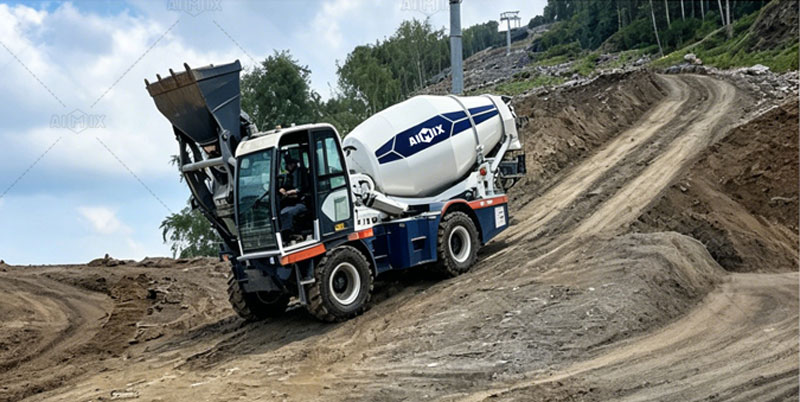
When Ghanaian contractors and investors evaluate self loading concrete mixer machine prices, the figures they encounter across different suppliers and configurations can vary by tens of thousands of dollars for machines that appear broadly similar in output capacity and physical size. Understanding the sources of that price variation requires looking beyond the headline specifications — drum volume, output rate, water tank capacity — into the engineering systems that actually determine how the machine performs, how long it lasts, and what it costs to keep running across a multi-year operational life in Ghana’s demanding construction environment.
The hydraulic system is where a disproportionate share of that price variation originates. Self loading concrete mixer for sale is fundamentally hydraulic machines — the loading bucket, drum rotation, drum discharge, travel drive, and steering functions all depend on hydraulic power transmission components whose specification, manufacturing quality, and system architecture vary considerably across the price range available in the Ghanaian market. A hydraulic system built from internationally recognized brand components to a well-engineered circuit design performs differently — and costs differently to purchase, maintain, and operate — than one assembled from lower-cost alternatives to achieve a more competitive unit price. The full financial implications of that difference become clear only when total cost of ownership is calculated across the realistic service life of the machine in Ghanaian operating conditions.
Hydraulic Pump Specification and Its Direct Impact on Machine Pricing
The hydraulic pump is the power source for every hydraulic function on a self loading concrete mixer. Its output pressure and flow rate determine the speed and force available for loading bucket operation, drum rotation torque, and travel drive performance. Its efficiency determines how much of the engine’s power output is converted into productive hydraulic work versus heat generation. And its service life under the continuous high-load operating cycles of concrete production determines how quickly it requires replacement and what that replacement costs in the Ghanaian market.

Axial Piston Versus Gear Pump Configurations
Self loading concrete mixers are available with either axial piston pump systems or gear pump systems as their primary hydraulic power source — a specification difference that has direct implications for both machine purchase price and long-term operating economics. Axial piston pumps deliver higher operating efficiency, variable displacement capability that adapts output to instantaneous demand and reduces unnecessary heat generation, and significantly longer service life under sustained high-pressure operation. They are the specification found on premium machine configurations from quality-focused manufacturers, and their cost contribution to the machine’s purchase price is measurable — typically adding 15 to 25 percent to the hydraulic system component cost compared to fixed-displacement gear pump alternatives.
Gear pumps offer a lower initial cost and simpler maintenance requirements that have genuine appeal in price-sensitive markets. However, their fixed displacement operation means the pump delivers maximum flow regardless of actual demand — a characteristic that generates higher hydraulic heat loads during partial-demand operating phases and imposes greater thermal stress on fluid and system components than variable displacement piston pump systems. In Ghana’s high-ambient temperature environment, where hydraulic thermal management is already challenged by elevated baseline temperatures, this additional heat generation from fixed-displacement pump operation can compress hydraulic component service life and increase cooling system demands in ways that offset the initial purchase price saving over time.
Brand Specification and Component Sourcing Transparency
Hydraulic pump brand specification is a procurement detail that significantly influences both machine price and operational risk profile. Machines fitted with Bosch Rexroth, Parker Hannifin, Kawasaki, or Sauer-Danfoss hydraulic pumps carry component costs that reflect the engineering quality, performance consistency, and global parts availability of these established manufacturers. Their presence in a machine’s specification adds to purchase price but reduces the operational risk associated with pump failure — replacement components are available through established distribution networks, technical specifications are documented, and repair expertise exists in most markets including Ghana’s growing construction equipment service sector.
Hydraulic Motor Quality and Travel Drive Performance
Travel drive hydraulic motors on self loading concrete mixer machine in Ghana determine the machine’s mobility capability — its ability to operate on the unprepared terrain, laterite surfaces, and wet-season ground conditions that characterize many Ghanaian construction sites. High-quality orbital or axial piston travel motors deliver consistent torque output, reliable speed control on grades, and service life commensurate with the machine’s overall design life. Lower-specification motors may provide adequate performance on firm, level ground but show performance limitations and accelerated wear under the demanding mobility conditions that Ghana’s construction environments routinely impose.
The price differential between machines fitted with quality travel drive motors and those using lower-specification alternatives reflects a genuine performance and durability gap that manifests in operational conditions rather than on the specification sheet. A machine that performs confidently on a compacted laterite site road during the dry season but struggles for traction on the same surface during Ghana’s rainy season has a travel drive limitation that reduces its productive utilization — a commercial consequence that compounds across the operational year in ways that the initial price saving cannot compensate.
Hydraulic Cylinder Design and Loading System Efficiency
The loading bucket hydraulic cylinders perform the most physically demanding repetitive function on a self loading concrete mixer — lifting aggregate loads of 500 kilograms or more through the full bucket elevation cycle, thousands of times across the machine’s operational life. Cylinder specification — bore diameter, rod diameter, seal material, and chrome plating quality on the rod surface — determines both the lifting force available and the service life of the sealing system that maintains hydraulic pressure integrity across years of continuous use.

Chrome Rod Specification and Seal Life in Tropical Conditions
Hydraulic cylinder rod surface quality is a component specification detail with direct relevance to operating cost in Ghana’s environment. Chrome plating thickness and hardness on the cylinder rod determines both the rod’s resistance to surface corrosion in Ghana’s humid tropical conditions and the wear rate imposed on the rod seal lip during each cylinder stroke. Thin or low-hardness chrome plating develops surface defects — pitting, scoring, corrosion pockets — that abrade rod seals progressively, compressing seal service life and creating hydraulic fluid leakage that reduces system pressure, contaminates the work environment, and requires increasingly frequent seal replacement.
Quality cylinder specifications from reputable manufacturers use hard chrome plating to defined thickness and hardness standards, with surface finish quality controlled to limits that maintain seal integrity across the full design service life. The cost of this specification is reflected in machine purchase price. The alternative — frequent hydraulic cylinder seal replacement, the labor cost of that maintenance, and the production downtime it requires — represents an operating cost stream that price-focused procurement decisions often fail to account for adequately when comparing machines at different price points in the Ghanaian market.
Hydraulic Hose Specification and Routing Design
Hydraulic hose specification and routing design are frequently overlooked aspects of self loading mixer hydraulic system quality that influence both purchase price and operational reliability. High-pressure hoses rated appropriately for system operating pressures, with abrasion-resistant outer sheaths and end fittings crimped to defined quality standards, resist the pressure cycling fatigue and physical abrasion that working on construction sites imposes. Hose routing design that protects hoses from contact with moving components, sharp edges, and heat sources extends service life beyond what even correctly specified hoses achieve when routed carelessly.
Total Cost of Ownership: The Framework That Resolves the Price Comparison
The purchase price of a self loading concrete mixer in Ghana is the entry point of a financial relationship that extends across five to ten years of operational service. Evaluating that relationship through total cost of ownership — integrating purchase price, hydraulic system maintenance costs, component replacement intervals and costs, productivity implications of hydraulic system performance, and residual value at end of service life — provides the analytical framework that resolves apparent price comparison dilemmas into clear investment decisions.
Maintenance Cost Modeling for Hydraulic System Variables
A structured maintenance cost model for self loading large concrete mixer hydraulic systems incorporates hydraulic fluid replacement intervals and costs, filter element replacement frequency, seal kit costs and replacement labor for cylinders and motors, pump and motor overhaul intervals and costs, and hose replacement frequency. Applied across different machine configurations at different purchase price points, this model consistently reveals that hydraulic system quality differences that appear modest at the component specification level generate maintenance cost differentials over a five-year operating period that frequently exceed the initial purchase price difference between machine configurations. Ghanaian contractors who have operated multiple machine generations across their fleet have developed this understanding through operational experience — a learning that increasingly shapes procurement decisions toward quality-specified hydraulic systems despite their higher initial acquisition cost.
Residual Value and Resale Market Implications
Ghana’s growing second-hand construction equipment market provides a resale value reference that further informs the total cost of ownership comparison between hydraulic system quality levels. Machines with recognized brand hydraulic components, documented service histories, and hydraulic systems in serviceable condition command measurably stronger resale prices than machines with non-standard components, undocumented maintenance histories, or hydraulic systems showing signs of deferred maintenance. The residual value advantage of quality-specified machines, captured at end of ownership, contributes to the total cost of ownership calculation in a direction that consistently favors the higher initial investment in hydraulic system quality — making the premium purchase price a rational financial decision rather than simply a preference for better engineering.

Comments
No comments yet. Be the first to react!